

The FOMC left the federal-funds rate unchanged at 3.50%–3.75%, but the decision came with a notably hawkish 9–3 vote. Cleveland Fed President Beth Hammack, Minneapolis Fed President Neel Kashkari and Dallas Fed President Lorie Logan all preferred a 25-basis-point hike. This degree of dissent within the FOMC is unusual, signaling that there is considerable debate as to whether additional monetary policy tightening is necessary.
The FOMC statement didn’t offer any additional clarity, maintaining the brevity of Warsh’s first FOMC statement:
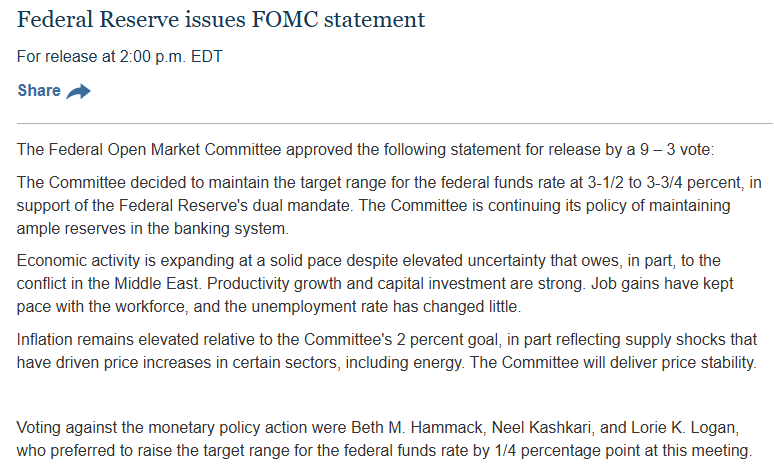
The statement concludes by committing to delivering price stability, while also partially attributing higher energy prices to the conflict in the Middle East.
Equities and precious metals initially cheered the Fed decision and the beginning of Warsh’s press conference. However, as reporters pressed Warsh on inflation—and questioned how he could justify holding rates steady while acknowledging that inflation remained above the FOMC’s target—it became increasingly clear that the chairman had lost the plot.
“Fed Guy” Joseph Wang does a good job of recapping the Warsh presser, and the two key responses which may have unsettled markets:
When asked by a reporter from the Associated Press which inflation measure he is relying on, Warsh responded with a unique word salad that would have made Greenspan jealous:
Paul Wiseman (Associated Press): When you talk about the 2% inflation target, what measure are you relying on?
Federal Reserve Chairman Kevin Warsh: Yeah. So, I’ll give two answers. First, let me give the proper standard answer. The Federal Reserve, every January outlines a statement of purposes and strategy. And in that strategy document, which I believe was dated January of this year, it describes a measure of PCE inflation as the objective function there.
So that’s our number. We’re sticking with it. Who knows come after next January what we might say about strategy. I suspect the task forces might might have something to add. But I’ll say this, some version of the Lucas critique, some version of Goodhart’s Law and Economics should remind us that when we talk about measures of inflation, or something else, and we describe those measures as being consistent with our objectives, we might make them such that they’re not very good measures or very good objectives.
Broadly, if you said to me standing in front of you, I abide fully by the strategy document we’re going to deliver 2% inflation and not a whisper more. But to achieve that I’m looking at a broader set of inflation data than PCE. So without sort of fully revealing my cards, I’m trying to understand like my colleagues, what’s the underlying generalized change in prices that are happening in the economy.
So it’s not core PCE, it’s something else, but he doesn’t want to tell us what it is. He’s trying to understand the underlying (core) generalized change in prices across the economy, but he’s unwilling to shed more light on how to measure those changes, or which changes he’s even measuring.
Unsettling.
Wang was especially harsh in judging Warsh’s performance. I found the press conference to be annoying, but I wouldn’t give him an F. In my opinion, it was more of a D+ type of performance.
It was poor, but it wasn’t a total failure. There were some redeeming features of the presser, including Warsh’s admission that the Fed can’t snap its fingers and magically achieve 2% inflation.
However, I do agree with Wang that if Warsh isn’t willing to say much of substance then he simply shouldn’t speak. Speaking in gibberish, and/or extremely vague language, isn’t doing him or the Fed any favors.
Mr. Market didn’t find it amusing when Warsh danced around the question regarding how he is measuring inflation.
In fact, markets began to roll-over during Warsh’s response to the AP reporter’s question, and equities ended up closing at session lows…
SPY (5-Minute)
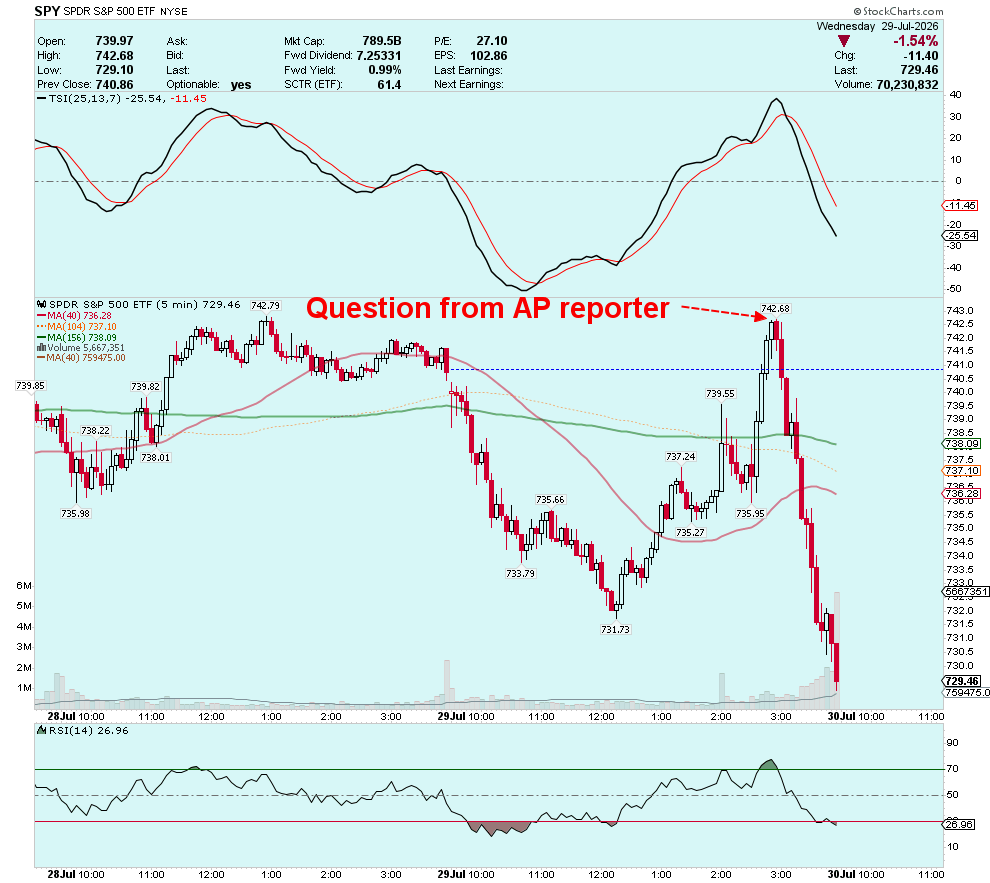
Lack of transparency, and extremely vague answers to critical questions does not inspire confidence in the world’s most powerful central banker.
As Luke Gromen pointed out recently, Warsh doesn’t have any appealing options. Doing nothing, and waiting to see how things play-out in the Middle East is probably the option that does the least harm in the near term.
However, with real yields strongly in positive territory and moving higher today, the Fed finds itself between a rock and a hard place. Financial conditions have substantially tightened in the last couple of months. In fact, they are tight enough that real yields should be pressing down on inflation. However, the world is dealing with exogenous supply shocks resulting from the conflict in the Middle East. Throw in the AI capex ‘shock’, and the world is finding it more challenging to match supply and demand.
To be clear, I was confident the Fed would not raise rates today, and I am equally confident that the odds strongly favor it remaining on hold through year-end. A trapped Federal Reserve, confronting a debt-to-GDP ratio near 125% and annual deficits exceeding $2 trillion, has an increasingly limited policy toolkit. Sustained positive real Treasury yields only accelerate the arrival of the next crisis—when the Fed will be forced to “assist” Treasury-market functioning. We know this policy as yield-curve control, although it will almost certainly be given a more palatable name to disguise its true purpose.
I expect gold will increasingly become positively correlated with long-term Treasury yields. The higher yields rise, the faster that crisis point approaches. Think back to March 2020, when the COVID shock briefly threatened the functioning of the Treasury market and forced the Fed to intervene aggressively. The next crisis will likely rhyme with March 2020, although the catalyst, details and exact timeline will inevitably look different.
“It’s going to go up — I think the market’s going to go through the roof.” ~ President Donald J. Trump, July 6, 2026
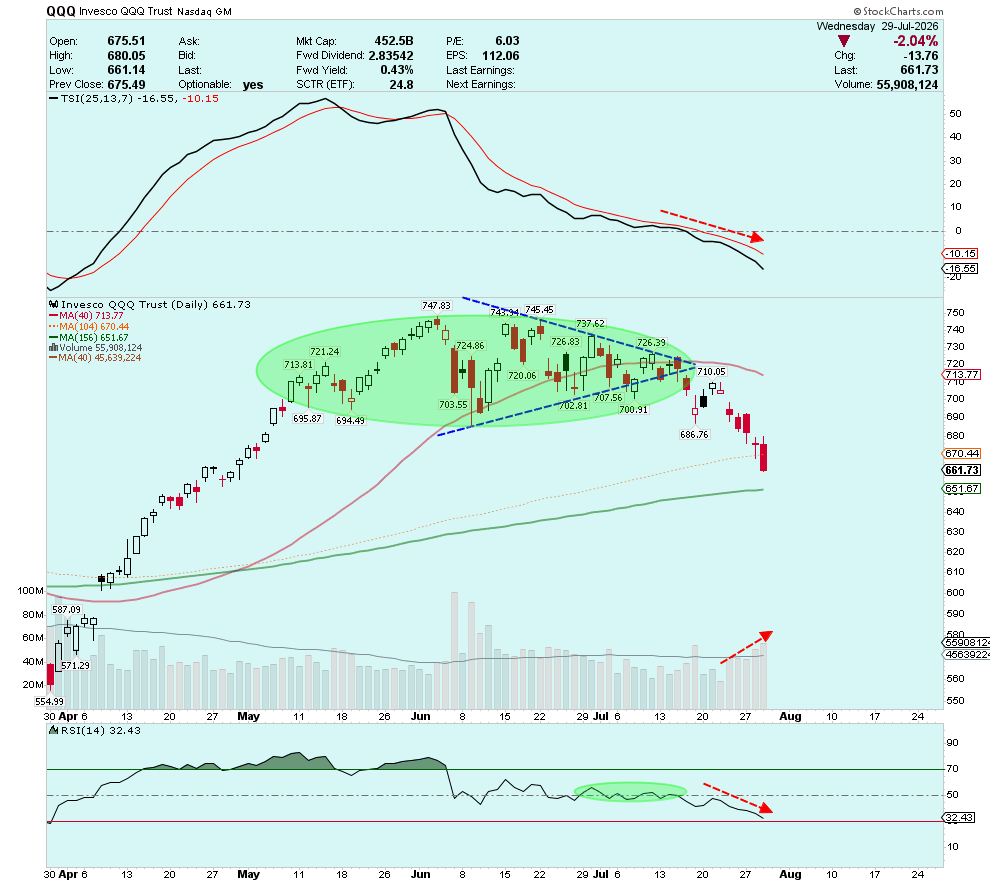
Three weeks ago, I wrote about a “Bearish Brew For US Equities”—that bearish brew is playing out as I envisioned. In fact, it’s happening even faster than I anticipated, aided by an accelerating unwinding of the “AI trade” and a failure of the Iran/US MOU.
QQQ (Daily)
Finally, I want to reiterate that the gold miners are in the midst of a sweet-spot setup that could last through the end of next week. That means that now is the time to be deploying capital across this sector, before a precious metals rally unfolds in August/September.
Agnico Eagle Mines (NYSE:AEM) just delivered another stellar quarterly report that included record free cash flow of US$1.34 billion, and a 50% increase in quarterly net income year over year.
Agnico Eagle Mines (Daily)
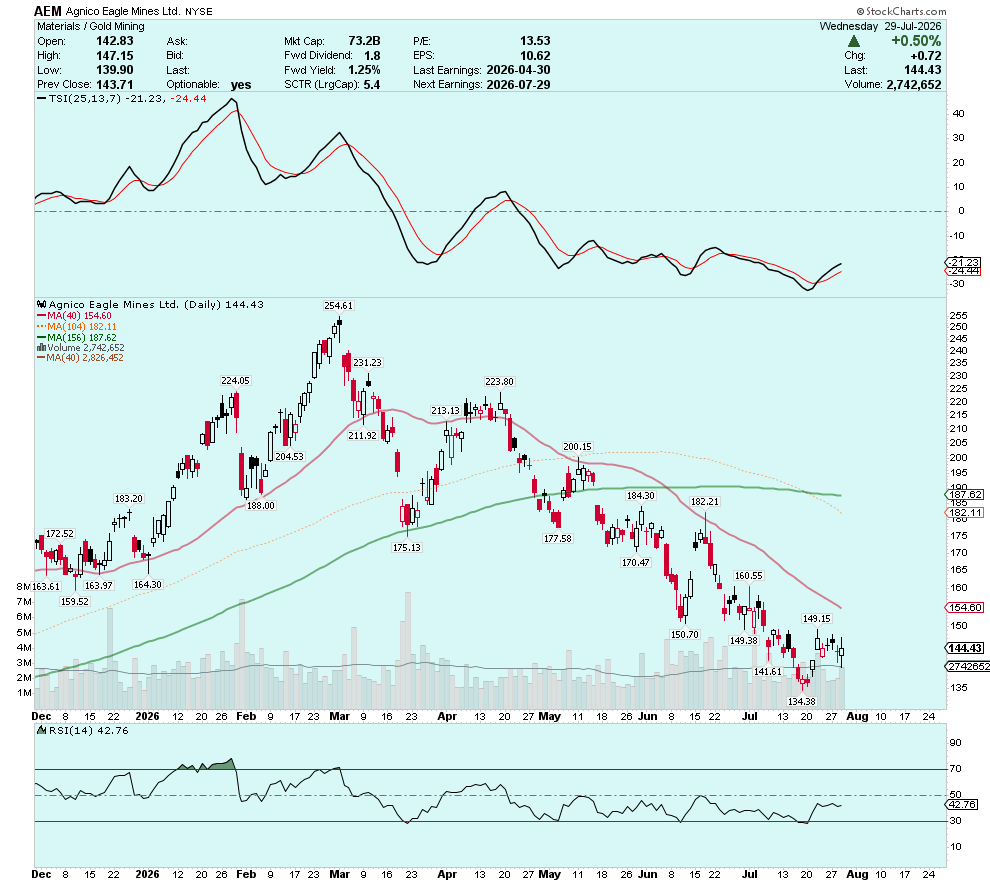
Gold miners are being priced as though gold is headed substantially lower. After a roughly 40% drawdown, investors have abandoned the sector—even as producer balance sheets have never been stronger and their earnings power has never been greater.
The time to be a buyer in precious metals was not back in January, when silver was making headlines, and inflows into gold funds were breaking records.
The time to be a buyer is now.
Disclosure: Author owns shares of Agnico Eagle Mines at the time of publishing and may choose to buy or sell at any time without notice.
DISCLAIMER: The work included in this article is based on current events, technical charts, company news releases, corporate presentations and the author’s opinions. It may contain errors, and you shouldn’t make any investment decision based solely on what you read here. This publication contains forward-looking statements, including but not limited to comments regarding predictions and projections. Forward-looking statements address future events and conditions and therefore involve inherent risks and uncertainties. Actual results may differ materially from those currently anticipated in such statements. This article is provided for informational and entertainment purposes only and is not a recommendation to buy or sell any security. Always thoroughly do your own due diligence and talk to a licensed investment adviser prior to making any investment decisions. Junior resource companies can easily lose 100% of their value so read company profiles on www.SedarPlus.ca for important risk disclosures. It’s your money and your responsibility.