

For the second time in 2026, I’m referring to a Ray Dalio interview. Generally speaking, I don’t find Dalio particularly compelling. However, it’s very clear that he is tuned in to the final stage of the Fourth Turning and the major social, economic, and monetary transformations now underway.
I normally wouldn’t link to Tucker Carlson interviews or delve into political structures on this blog, but this is a moment in which these subjects could not be more important. We are living through the critical final years of a world order that has existed for roughly 85 years—one that was assumed to be sacrosanct until just last year. It is a monetary system that has been in place since 1944 and now appears to be unraveling into a multipolar framework with an unclear foundation.
In a recent interview with Tucker Carlson—who has been landing some excellent guests lately—Dalio describes what he sees as the inevitable transition from democracy to autocracy:
Dalio: “In 350 B.C., Plato wrote about the cycle in the Republic. In other words, democracies, and the challenge of democracies where you vote….But then there’s the the wealth gaps and the rich gaps and then who has the money? And then the not willing to vote and then there’s changes in power.”
Carlson: “So partisanship becomes gridlock which becomes an irreconcilable mess, and then that evolves by necessity into autocracy.”
Dalio: “Right? When I’m no longer willing to accept the system, the rule of the system because everybody thinks it’s rigged. Is the Supreme Court rigged? Because that partisan has more appointees and it won’t be fair.
I remember when the Supreme Court was kind of the Supreme Court, and we lived in a time where we said the system is fair…..When that ceases to be the case (when the legal system is no longer fair), when the causes that people are behind are more important to them than the system, the system is in jeopardy, right? “
Carlson: “Yes, of course, by definition. And you know, all this is relevant to where we are now. So tribalism, whether it’s political or ethnic, but when people square off into tribes and they have no common ground, and they have no hope of reconciling or compromising, then you’re getting a new system.”
And once you acknowledge that everyone is picking sides and sticking to their tribes, Dalio explains how every citizen has one of three choices:
Dalio: “One of three things: 1) You have to pick a side and fight for it , 2) or you keep your head down and hope you don't get shot, or 3) flee.”
This dialogue between Tucker and Dalio hit me hard. It perfectly captures the situation we are living through today: everyone is entrenched on a side, and the differences between those sides are becoming increasingly irreconcilable. Each side is dehumanizing the other, and the legal system has been politicized by both.
Call me a skeptic, but I don’t see how this situation de-escalates before it escalates much further. We appear to be cruising toward a major escalation in political tension within the United States as 2026 progresses, potentially culminating in a blowout around the midterm elections in November.
Thus far, no unifying figure has emerged within the American political landscape. In fact, the figures who have emerged are more likely to generate further division. That suggests American society may become more extreme and increasingly radicalized before a true breaking-point event occurs.
Later in the conversation, Dalio discusses his six-stage cycle, noting that we are currently in Stage Five. Stage Six represents the breakdown of monetary and societal order.
The recent rise in the gold price is a symptom of the growing risk that a Stage Six breakdown lies ahead.
Gold (Weekly)
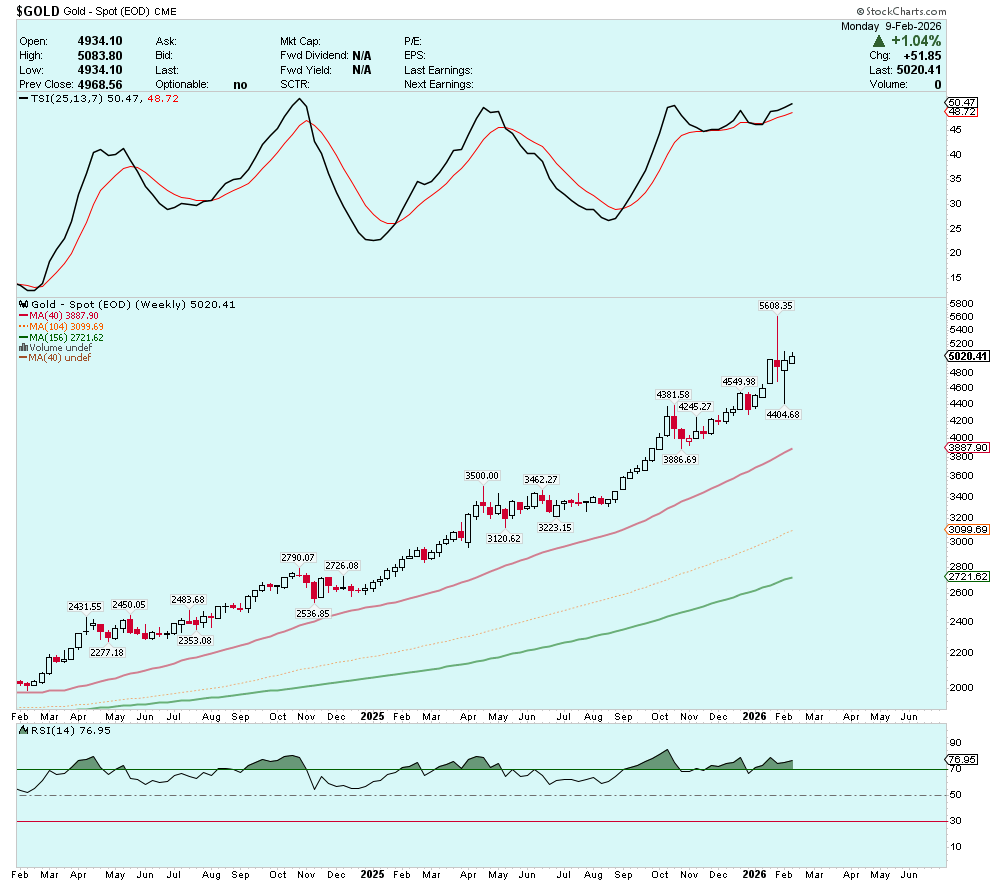
Beginning at the 34:00 mark, Dalio and Carlson discuss gold and its role as money, the most durable money that has stood the test of time.
“Gold is the one asset you can have that's not somebody else's liability.” ~ Ray Dalio
It’s well worth tuning in for the full conversation.
I would like to review The Fourth Turning, and how the final years of The Fourth Turning (crisis period) are expected to unfold according to the framework set forth in the book by Neil Howe. By understanding what is already underway, and how it is likely to evolve, we can be better informed investors. And maybe even better Human Beings.
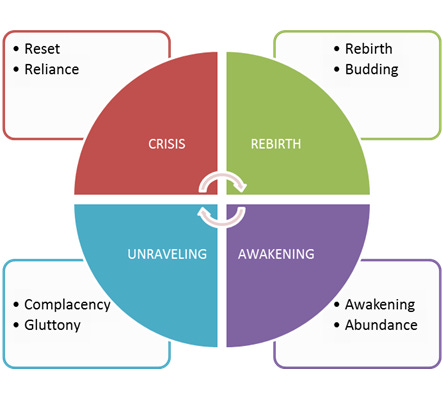
In the final years of the Fourth Turning, according to the The Fourth Turning framework, societies enter a period of intensifying stress in which long-standing institutions lose legitimacy faster than they can be reformed. Political systems polarize, financial structures strain, and public trust in elites collapses. What begins as diffuse anxiety hardens into decisive confrontation—often triggered by a catalyzing crisis such as war, financial collapse, or systemic failure. Compromise becomes rare; history accelerates. The defining feature of this phase is not chaos for its own sake, but forced choice: societies must decide what is worth preserving, what must be dismantled, and what new rules will govern collective life.
Who benefits during this final crisis phase?
The beneficiaries are highly asymmetric. Those tied to the existing order—financialized elites, bureaucratic institutions, over-leveraged systems, and cultural gatekeepers—tend to lose power, credibility, and wealth. The Fourth Turning is hostile to rent-seeking and abstraction; it punishes systems that grew detached from productive reality. In contrast, people and entities aligned with real assets, national cohesion, and practical competence often gain. This includes builders rather than financiers, producers rather than speculators, and actors capable of operating amid volatility—whether that means industrial capacity, energy, food, metals, defense, or social leadership rooted in tangible outcomes. Younger generations, especially those forced to mature quickly under crisis conditions, often rise into leadership faster than in prior eras.
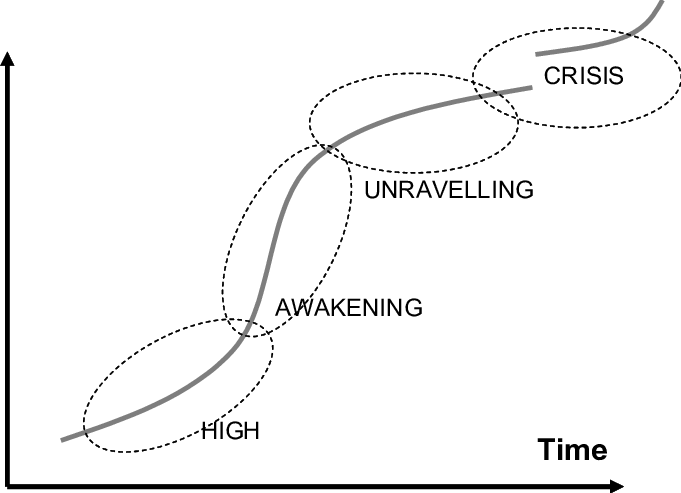
Socially and psychologically, the Fourth Turning compresses time. Moral clarity replaces ambiguity; narratives simplify into shared purposes. Sacrifice becomes socially acceptable again, even admired. Individualism gives way—sometimes willingly, sometimes forcibly—to collective action. This can be uncomfortable or even frightening, as personal freedoms may narrow temporarily in favor of survival and cohesion. Yet this same compression produces extraordinary alignment: large projects suddenly become possible, norms reset rapidly, and ideas that once seemed politically impossible become inevitable. The culture hardens, but it also regains coherence.
What Emerges At The End Of The Crisis Period?
What emerges at the end is a new civic order. Institutions are rebuilt—or replaced—on principles forged by crisis rather than convenience.
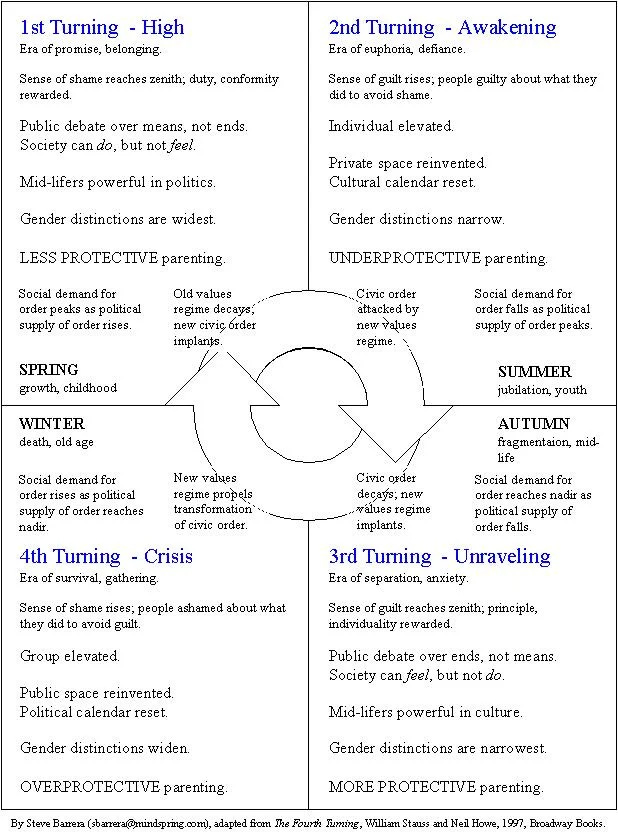
The post-Fourth Turning world typically features stronger (though not necessarily larger) government, clearer national priorities, re-anchoring to productive economic foundations, and a renewed social contract between citizens and the state. The winners are those positioned for the reconstruction phase: long-term thinkers, capital allocators focused on durability, and societies that emerge with shared identity intact. The losers are the illusions of the prior era—excess leverage, moral relativism, and systems optimized for comfort rather than resilience. In Strauss-Howe terms, the Fourth Turning ends not with collapse, but with resolution: a hard reset that clears the ground for a new First Turning—and a new cycle of growth.
A hard reset with hard assets as a foundation of the rebirth.

DISCLAIMER: The work included in this article is based on current events, technical charts, company news releases, corporate presentations and the author’s opinions. It may contain errors, and you shouldn’t make any investment decision based solely on what you read here. This publication contains forward-looking statements, including but not limited to comments regarding predictions and projections. Forward-looking statements address future events and conditions and therefore involve inherent risks and uncertainties. Actual results may differ materially from those currently anticipated in such statements. This article is provided for informational and entertainment purposes only and is not a recommendation to buy or sell any security. Always thoroughly do your own due diligence and talk to a licensed investment adviser prior to making any investment decisions. Junior resource companies can easily lose 100% of their value so read company profiles on www.SedarPlus.ca for important risk disclosures. It’s your money and your responsibility.
the planets are aligned ...