

For the last decade, the market has rewarded software, financial engineering, and asset-light business models. Billionaire entrepreneur Robert Friedland is arguing that the next decade may reward the opposite: copper, silver, gold, power, grid infrastructure, critical minerals, smelting, refining, and the companies capable of finding and building new mines.
The key line of thinking is simple: AI, electrification, defense, and deglobalization are all converging on the same bottleneck — the physical world. And the physical world cannot be coded into existence. It must be drilled, mined, permitted, processed, financed, and built.
The growing number of global wars in combination with the transition from a “just in-time” global economy to a “just in-case” global economy tremendously favors a “revenge of the miners”.
Some choice soundbites from Robert Friedland’s most recent conversation with SmarterMarkets™:
Most people still don’t understand how we make the things that we consume, the smartphones we use all day long, and the things we are transported in.
“The supply chain is a mystical concept for people who live in an urban environment.”
On the long investment time horizon in mining…
“Miners are in a different position because we are cooking a meal that we set-up 10-20 years ago, there’s not much we can do about it, but we certainly don’t want to mess up our diesel fuel. We hate shutting the mine down.”
On the complexity and metal suite required to make a new iPhone…
“….today’s commodities are so much more sophisticated. Like people don’t even know what scandium is or rhenium or tantalum or niobium or dysprosium. Yeah, you go through the periodic table. When Steve made the first Apple I phone, it had about 18 elements in the periodic table. It’s quite a lot. This one’s (iPhone 17) around 74 elements in the periodic table.
And without it, you can’t do a TikTok or get a hold of your kids. Like people don’t understand we’re going to go back to the Apple I one here shortly.”
On the difficulty of reaching a peace deal between the US and Iran….
“we do need to learn to live with each other. And you can only negotiate with your enemy. And you’ve got to reach a middle position. It’s just that this is easier said than done in this particular culture, I think is a little bit easier said than done….
I do think that it's hard to be a peacemaker. And it's hard to reach an acceptable compromise. I'd prefer to see one for my grandkids, right? But for our children and our our grandchildren we better make a deal. But when you look at the history of our species it's not very encouraging.”
On speaking to University students in Southern California, and the concerns of our youth….
“I went to the University of Southern California and I gave a lecture about copper and how the world works to a bunch of 19 and 20-year-olds. There was a whole ocean of them. And I found that these super young kids, that generation, are super worried about the world they’re growing up in. And they’re very smart.
And I got mobbed. I mean, I literally got mobbed. I got 4.3 million views on a video some kid took of me talking, right? And I’m like a dinosaur. I’m talking about mining and copper. They got it, you know, they understood it, right? And they’re deeply concerned about a lot of issues.
Some of them are concerned about global warming or how are they going to afford what they’re going to do with their life? Is AI going to take their world away from them? Are the robots going to do everything and they’re going to have nothing for them to do?”
On rising copper demand, and one of the many reasons that war is incredibly stupid…
“Now we’re going to use another 700 million metric tons at current consumption in the next 18 years. So we have to mine as much copper in the next 18 years as we’ve mined the last 10,000 years to maintain 3% global GDP growth. Now that’s without electric cars and data centers. Now that’s accretive, when you have an energy transition, that’s on top of that.
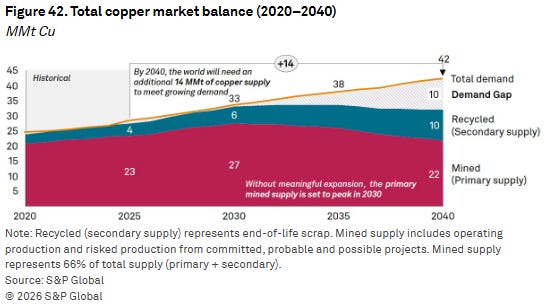
And when you waste all this copper on war then it gets even harder. War is like really stupid, you know, because it chews up astronomical amounts of metal that’s frequently not recyclable. When a shell blows up in Ukraine, boom, the copper in that shell is scattered all over hell and gone. It’s very hard to recycle it.”
We may begin to see a competition for resources between military/defense applications and civilian technology demand.
“The whole military industrial complex is undergoing a revolution that is metals intensive. Now where does this molecule of copper go? Does it go to the military or does it go to generate power so that your daughter can look at TikTok or to build a data center? Which one’s more dangerous?”
Key Highlights
1. “Revenge of the miners” is still early.
Friedland’s central message is that the world is moving from a financialized, asset-light economy back toward the physical economy — metals, energy, infrastructure, mines, smelters, grids, ports, rail, and supply chains. He argues that the real “revenge of the miners” has not fully arrived yet; we are still in the “foothills of the Himalayas.”
2. The old “just-in-time” economy is becoming a “just-in-case” economy.
Friedland emphasizes that governments and corporations are waking up to supply-chain vulnerability. Critical minerals are no longer merely commodities; they are national-security inputs. The shift from efficiency to security means hoarding, stockpiling, friend-shoring, and strategic procurement could become major sources of incremental demand.
3. Copper is already strong, but the real structural deficit is still ahead.
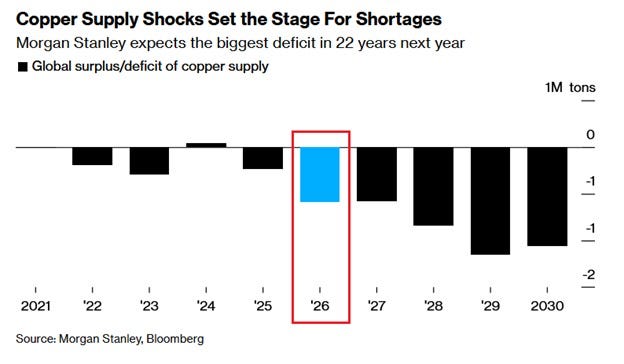
Friedland is not saying copper is in its final blow-off phase today. In fact, he argues the current copper market is still roughly balanced, or only modestly tight. His much more bullish view is several years out, when underinvestment, permitting delays, declining grades, grid buildout, AI demand, military demand, and supply-chain hoarding collide.
4. AI is a metals-and-energy story, not just a software story.
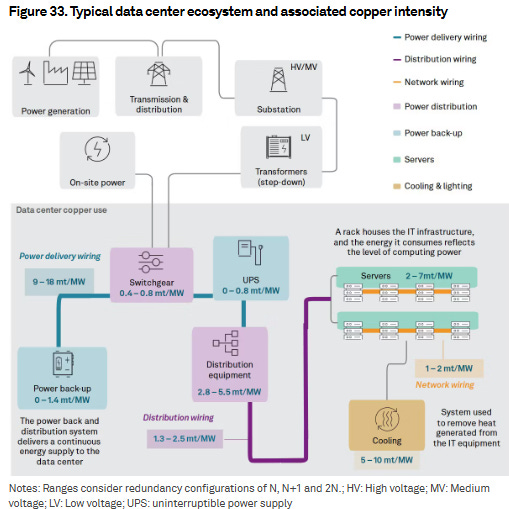
A major theme is that AI hyperscalers are moving from asset-light business models into asset-heavy infrastructure. Data centers require land, steel, power, copper, cooling, turbines, transformers, grid connections, and enormous capital.
5. The power grid is the bottleneck.
Friedland repeatedly returns to the question: where will the electricity come from? He argues that AI, data centers, humanoid robots, electrification, and military technologies all require a scale of power generation and transmission that the West is not currently prepared to deliver. He describes the U.S. grid as old, fragile, and underbuilt for the coming demand wave.
6. China owns the “middle economy.”
One of Friedland’s strongest points is that China spent decades building the industrial middle: ships, ports, rail, smelting, refining, manufacturing, heavy equipment, and mineral supply chains. The West, by contrast, financialized its economy and hollowed out key industrial capabilities. Friedland uses the example of Ivanhoe needing giant pumps after a mine flooding event: Western suppliers quoted years; China manufactured and delivered in months.
7. Mining supply chains themselves are breaking down.
It is not just that the world needs more mines. The world may struggle to build the mines because the equipment supply chain is also constrained. Friedland cites long lead times for motors, pumps, turbines, and other heavy industrial equipment — in some cases several years — because these components depend on complex global supply chains and critical metals.
8. Copper has no easy “shale revolution” equivalent.
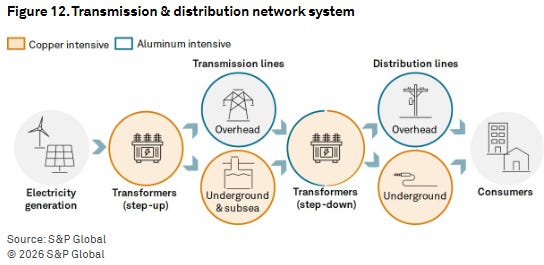
Copper cannot be substituted easily; copper is ductile, highly conductive, reliable, and difficult to replace in many applications. Aluminum can substitute in some uses, but for data centers, bus bars, grids, and high-reliability electrical systems, copper remains extremely difficult to displace.
9. The market is still massively underweight real assets.
Financial assets have dramatically outperformed commodities since 2014, leaving institutional portfolios structurally underweight energy, mining, and hard assets. If even a small portion of capital rotates out of tech and financial assets into commodities and mining equities, the move could be explosive.
10. Mining equities are historically ignored — which is part of the opportunity.
Friedland notes that mining companies require billions to discover, permit, engineer, and build mines, yet they often endure a multi-year “valley of death” where investors ignore them during construction. He argues that sovereign wealth funds and strategic capital are beginning to recognize the value of raw materials, but the broader market has not yet fully rotated.
11. A real metals bull market has not been seen by most modern investors.
Friedland points back to the Voisey’s Bay / Diamond Fields era as an example of what a true metals equity bull market can look like. His point: most younger capital allocators have never experienced a genuine mining bull market, which means they may underestimate how violent the rotation can become once it starts.
12. The most explosive moves may come in obscure strategic metals.
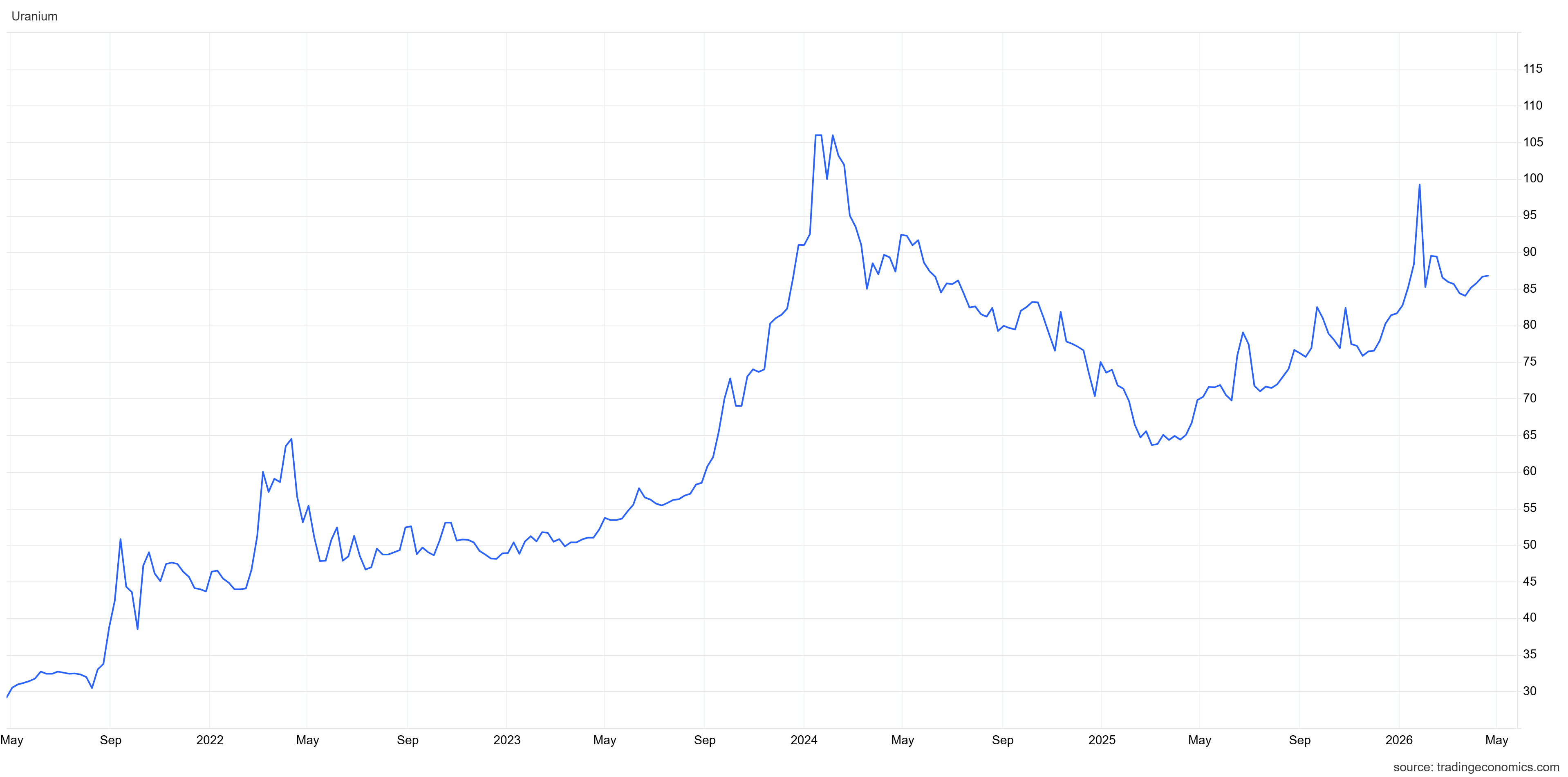
Friedland specifically flags scandium, uranium, niobium, and tantalum as examples of thinly traded, opaque, national-security-linked metals that could rise 10x, 20x, or even 50x under the right conditions. His argument is that when military or aerospace demand becomes urgent, traditional NPV models go out the window.
DISCLAIMER: The work included in this article is based on current events, technical charts, company news releases, corporate presentations and the author’s opinions. It may contain errors, and you shouldn’t make any investment decision based solely on what you read here. This publication contains forward-looking statements, including but not limited to comments regarding predictions and projections. Forward-looking statements address future events and conditions and therefore involve inherent risks and uncertainties. Actual results may differ materially from those currently anticipated in such statements. This article is provided for informational and entertainment purposes only and is not a recommendation to buy or sell any security. Always thoroughly do your own due diligence and talk to a licensed investment adviser prior to making any investment decisions. Junior resource companies can easily lose 100% of their value so read company profiles on www.SEDARplus.ca for important risk disclosures. It’s your money and your responsibility.